VOLA: A Tribute to Slow Processes

Copyright VOLA A/S
VOLA as Vision Partner
VOLA is a central part of Denmark’s design heritage, with more than 50 years of experience and a clear focus on durability, timeless design, and uncompromising quality.
As a Vision Partner of the Danish Design Award, VOLA helps shape and strengthen the award’s ambition to promote design that combines craftsmanship, functionality, and responsibility – and that creates real impact.
Together, VOLA and the Danish Design Award work to advance Danish design both nationally and internationally. Read more about our partners
A Vola design duo encourages a new generation of designers to slow down the design process and strive for products built to last for decades. At the same time, they acknowledge that taking your time is a privilege.
More than 400 sketches. Cardboard and 3D models. Countless meetings, doubts, and uncertainties - and seven years.
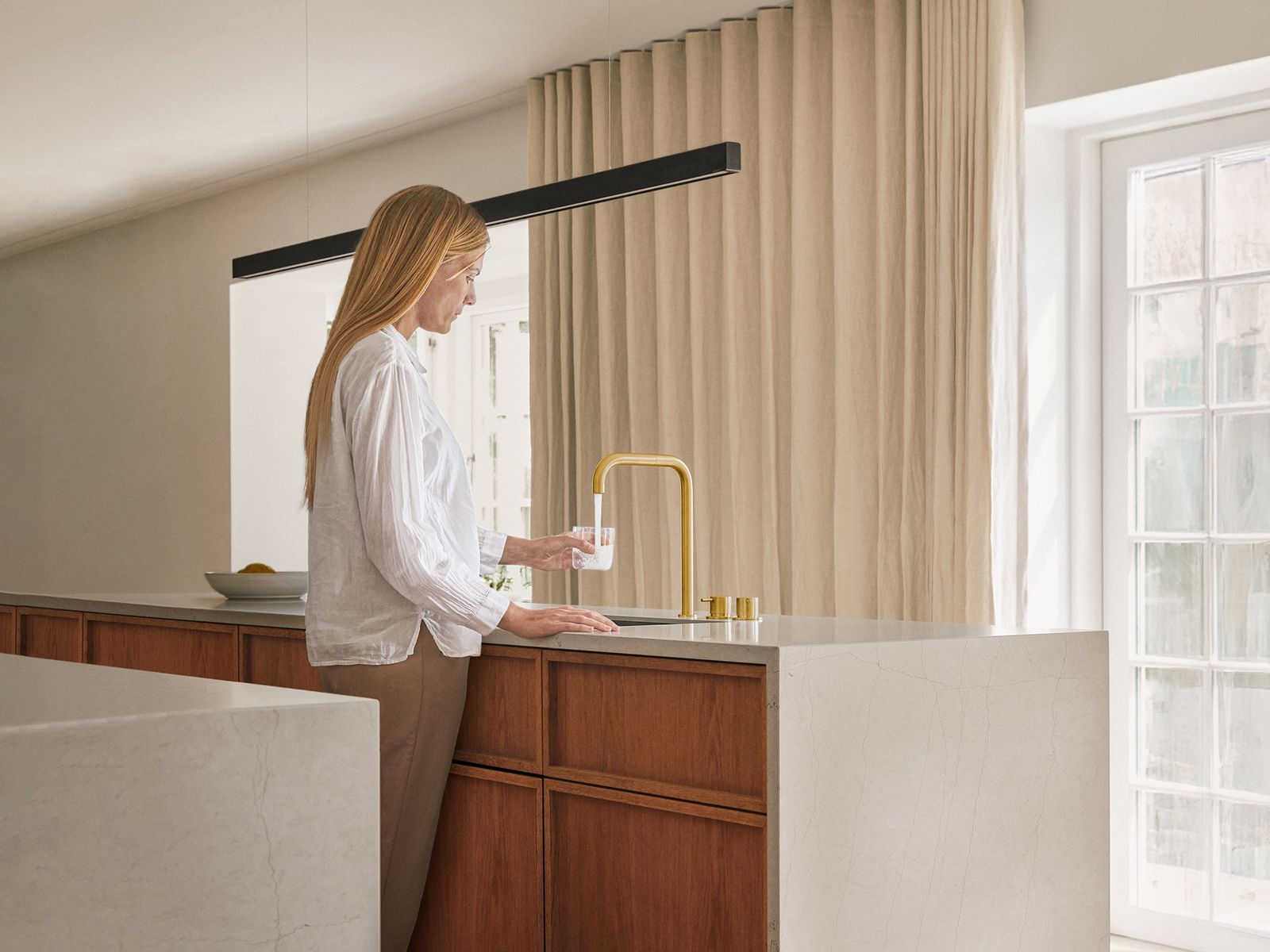
Those were the ingredients behind the KV5 faucet, introduced by the design company Vola in 2025. The KV5 can dispense five types of water, and behind the design is the design duo Mogens Kristensen and Torben Madsen, who have been designing Vola’s products since the 2000s.
Seven years might sound like a long time for a single product. But to the designers, that slowness is a key quality.
“There is immense value in thoroughly working through, testing, and discussing things before they become an actual product,” says Torben Madsen.
For them, it’s not about pushing out new items at all costs, but about understanding when something truly feels like Vola.
That takes time. In 2006, while designing the Vola Academy building, they spent six months analyzing the company’s existing lineup. That analysis became their internal compass whenever new ideas were put to the test.
It proved especially useful during the development of the KV5, where technology dictated the design more than usual. At the same time, the new faucet had to fit seamlessly into Vola’s established universe and represent more than just a passing trend.
Because of this, time became a critical part of the process. Sketches and models passed back and forth between the designers and Vola, and discarded ideas weren’t seen as failures, but simply as necessary steps forward.
“If we’re going to convince both ourselves and Vola that it’s the right direction, we have to test every possibility,” says Mogens Kristensen.
“There is immense value in thoroughly working through, testing, and discussing things before they become an actual product”

Toben Madsen (left) & Mogens Kristensen (right). Copyright VOLA A/S.
Call for new designers
This slow approach also applies when an idea moves from the screen into physical hands.
“We often see architects and designers go on Pinterest and Instagram, picking up an idea and expanding on it digitally. We encourage people to sit down with physical elements, feel the materials in their hands, and watch the design come alive right in front of them,” says Torben Madsen.
It’s all about discovering whether the product actually works and if the proportions make sense in reality.
For the designers, this is also a stance against a design culture obsessed with constant releases. Because of this, they welcome the growing focus on longevity and sustainability within the industry.
“It has gradually become taboo to design something intended to last for only four years. We understand that design is a livelihood, but we have to protect quality,” says Torben Madsen.
At the same time, he acknowledges that having plenty of time to design is a luxury.
In an industry where novelty is usually rushed, Vola’s biggest provocation might just be its patience: the willingness to redraft the same idea, to catch a detail that falls short, and to wait another year.
“Good design is rarely what hits the mark on the first try,” says Mogens Kristensen.
“Good design is rarely what hits the mark on the first try”
Copyright VOLA A/S.
Three tips from the designers
1. Do your homework on the company you’re designing for
Mogens Kristensen and Torben Madsen spent six months analyzing Vola – from its geometric shapes and the details of its joints to how its products are manufactured.
Ever since, they have drawn on that knowledge as a fundamental understanding of what makes a Vola product what it is. This has made the collaboration much smoother.
2. Step away from the computer and get hands-on with the product
“You can do a lot on a computer, but if you try shaping the form with your hands instead, for example using a cardboard tube, it becomes immediately obvious when a proportion doesn’t work,” says Torben Madsen.
“Personally, we also find inspiration far away from the screen. It might be in a particularly well-concealed solder joint or screw. It could be something on a radio or a car, and then we start sketching – without worrying about whether what we draw looks like something people would normally associate with it,” adds Mogens Kristensen.
3. Keep your old sketches – you may need to revisit them
“When we sketch, we never crumple up a piece of paper and throw it away just because we’re not completely satisfied with it. That’s part of the process, too.
The pile just keeps getting taller, but it’s useful to revisit some of the discussions we had and back them up with an old sketch. And sometimes that turns out to be the idea we return to and develop further,” says Mogens Kristensen.